FULL PAPER FULL PACMMAN PAPER HERE
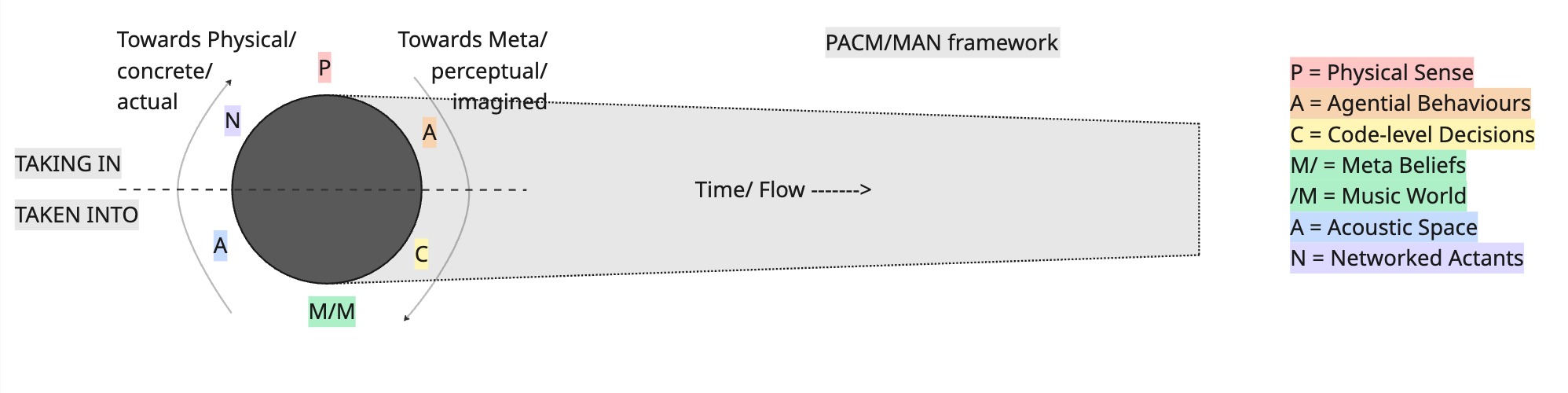
The PACMMAN framework of connections
The PACMMAN framework builds on the Taking-In/ Taken-Into concept originally presented in The Digital Score book. It also considers several other theoretical frameworks that have provided inspiration over the course of this project, for example Chris Small’s notion of Musicking, Simon Emmerson’s Living Electronic Music, and David Borgo’s Sync or Swarm, amongst others.
In the image above, the circle on the left-hand side is split into the 2 realms of the Taking-In/ Taken-Into framework with North being affordances and South which is more subjective and imagined. The diagram also suggests a movement between the two, although this is not a linear movement around the fields.
For the purposes of the survey, the seven fields were defined as:
- Physical Senses: The stuff we see, touch, read (notation), hear (reduced to physical sound, or harmonic relationships), bio/movement of other agents (human or machine)
- Agential Presence/ Behaviours: How we perceive the score behaving, the tangible presence or feel that something is there, the liveness of pre-recorded sound, the behavioural meaning of animation
- Code-base decisions: Reasoning presence, a mind in action, how we give meaning to random choices or generative AI, how we rationalise graphical behaviours or on-screen generative images, why something did what it did, or seemingly ignored me
- Meta beliefs: the contexts embedded within the score:
- MACRO: the cultural context within which it is positioned. e.g. the digital score is embedded with referential materials such as previous works, styles, identities
- MICRO: the aesthetic and artistic and cultural beliefs (its world view) that guide the operationality of the score. E.g. the digital score is embedded with specific interactive behaviours and belief governing it’s interactivity and/ or responses
- Music world: I am somewhere. The imaginary world a score conjures. The meta-physical space created by the score. E.g. in Nautilus this is NOT the Unity world (this is part of the Physical senses dimension), but it is the feel of the music, and the imaginary landscape in the musicians mind.
- Acoustic space: The actual acoustic space created by the realisation of the score. Using Emmerson’s Local/Field-Stage metaphor it has more to do with the physical evocation of space and how that is staged in the music. Additionally, it can describe the actual physical sensation of the acoustic space on the musician, and this might be different depending on performance spaces.
- Networks/ Participants: Those participating in the music. Representations of self and others as a complex network of inter-relationships. This could be fellow performers, audience, sounding objects. The focus is on the web of actants in a musicking network and its dynamics over time